
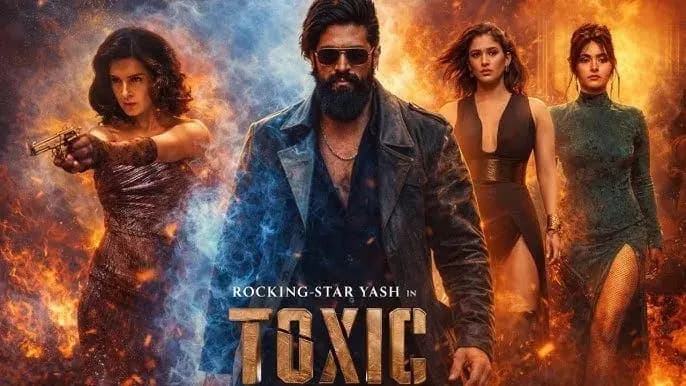
TOXIC: A Film That Has Audiences Talking — And Divided
Toxic: A Fairy Tale for Grown-Ups seems to begin a debate. Yash's much-awaited return to the big screen after KGF: Chapter 2 opened worldwide on August 26, carrying enormous expectations. Directed by Geetu Mohandas, the Kannada-led pan-India film arrived with a big cast, a dark gangster world and a visual style that clearly wanted to be different.
Some films end with the credits. Five days later, one thing is certain:
Audiences are not agreeing on this film.
Some are calling it bold, stylish and ambitious. Others are walking out wondering whether the story justified the scale of the production.
And perhaps that is what makes Toxic interesting to discuss.
The numbers say one thing. The reactions say another.
Toxic opened with a massive ₹101.10 crore net in India on its first day. By Day 5, its India net collection had reached ₹214.10 crore, while its worldwide gross stood at ₹285.20 crore — roughly $29.8 million. Its overseas gross was around ₹29.25 crore. Those are significant numbers. But the film has also seen a sharp drop after its huge opening, with mixed word-of-mouth becoming an important part of the conversation.
Interestingly, the Hindi version has emerged as a major contributor, showing that Yash's popularity has travelled well beyond the Kannada-speaking market. So commercially, Toxic has certainly made an impact. But the bigger question is whether audiences are emotionally connecting with it.
What people are praising
There is quite a lot to appreciate.
Yash's screen presence remains one of the film's strongest points. His performance, especially the intensity and physicality he brings to the characters, has received considerable praise.
The action sequences are another highlight.
So is the visual world created by Geetu Mohandas and her technical team.
The film has a distinctive look, with elaborate production design, dramatic lighting, large-scale sets and carefully constructed action sequences. Several reviewers and industry members have specifically praised its visual ambition and artistic approach.
There is clearly a filmmaker here trying to create something beyond a routine commercial gangster film.
And that ambition deserves recognition.
But the story is where the debate begins
The biggest criticism is not about the scale.
It is about the writing.
Many viewers have found the screenplay difficult to follow, with criticism aimed at the pacing, editing and the way different story elements come together. The film's long runtime — around three hours and 14 minutes — has also become part of the discussion. For some viewers, the unusual storytelling is exactly what makes Toxic different.
For others, the style becomes more noticeable than the story itself. That is an important distinction. A visually spectacular film can hold our attention for a while. But ultimately, audiences still want to know why they should care about the characters.
Yash is perhaps the film's biggest advantage
Whatever one's opinion of the screenplay, it is difficult to ignore Yash. His popularity after the KGF films gave Toxic enormous expectations even before release. That fan base has clearly turned up. But Toxic also asks Yash to move into a more unusual and darker space. That makes the performance interesting even for viewers who may not completely connect with the film itself. The film also has an impressive ensemble, including Nayanthara, Kiara Advani, Huma Qureshi, Rukmini Vasanth and others. Yet some reviews have questioned whether every character receives enough emotional depth within such a crowded narrative.
So, is Toxic good or bad?
That may be the wrong question right now. Toxic is clearly not a conventional commercial film. It is trying to combine gangster drama, family conflict, stylized action and a darker fairy-tale-like visual language. Sometimes that experiment works beautifully. At other times, the story struggles to keep pace with the filmmaking.
Even filmmaker Anup Bhandari, while praising the film's ambition and beautifully conceived sequences, pointed out that the attempt to combine mainstream commercial cinema with an unconventional visual and tonal world can make the film feel uneven.
That may be the fairest way to look at Toxic.
The ambition is visible. The craft is visible. The flaws are visible too.
THE EDITOR'S TAKE
Toxic may not be a film that everyone will love. But it is certainly a film that has started a conversation. And perhaps that is valuable in today's increasingly formula-driven commercial cinema. Geetu Mohandas has taken a major star and a huge production and attempted something visually distinctive rather than playing completely safe. Whether audiences ultimately embrace that experiment will become clearer in the coming weeks.
For now, Toxic sits in an unusual space:
A box-office success in its opening days, a visual spectacle for many, and a storytelling experiment that has clearly divided its audience.
And sometimes, the most interesting films are the ones that leave audiences arguing about them long after they leave the theater.
Box-office figures are based on reports available as of August 31, 2026, and may be revised as collections are updated.