
Arizona Housing Market Shows Signs of Balance as Phoenix Prices Rise Modestly and Growth Supports Demand
Phoenix-area home prices rose 2.39% year over year through the first quarter of 2026, while population growth, record business investment and continued home construction provide support for Arizona's housing market as it moves toward more balanced conditions.
By Arizona Asians Staff
Arizona’s housing market is entering the second half of 2026 in a more balanced position, with home prices in metro Phoenix still rising modestly while population growth, business investment and new housing activity continue to support longer-term demand.
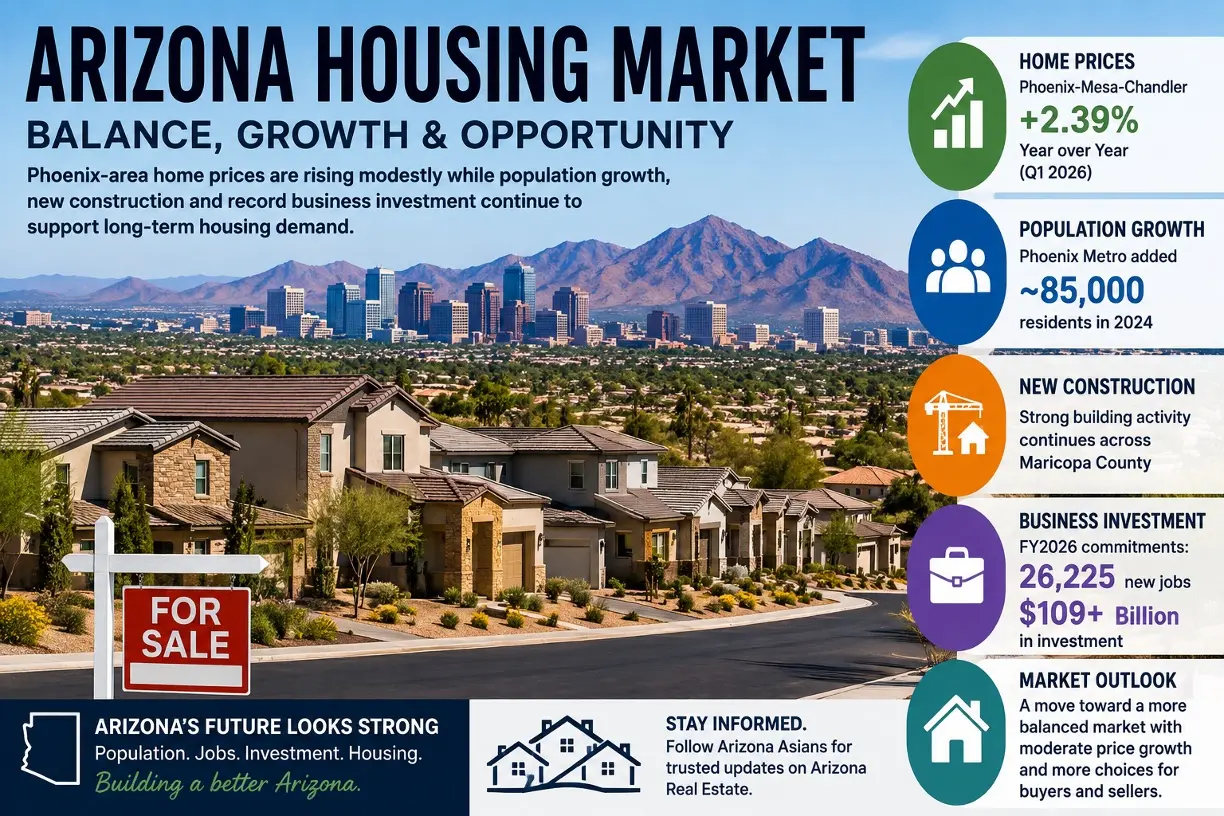
The latest federal housing-price data show that the Phoenix-Mesa-Chandler metropolitan area recorded a 2.39% increase in home prices over the year through the first quarter of 2026. Prices also increased 0.77% from the previous quarter, according to the Federal Housing Finance Agency.
Those gains are far below the rapid price increases Arizona experienced during the pandemic-era housing boom, suggesting that the market has shifted toward a slower and more sustainable pace.
Phoenix Home Prices Still Moving Higher
The FHFA House Price Index placed Phoenix-Mesa-Chandler at No. 168 among the nation's largest metropolitan markets for annual price appreciation in the first quarter of 2026. While that ranking indicates Phoenix is no longer among the fastest-appreciating housing markets in the country, prices have continued to move upward rather than falling sharply. For buyers, slower appreciation can provide more time to evaluate properties and financing options. For sellers, the market remains supportive, but pricing a home realistically is becoming increasingly important as buyers have more choices than they did during the highly competitive market of several years ago.
Population Growth Continues to Support Housing Demand
One of Arizona's strongest long-term housing fundamentals remains population growth. The U.S. Census Bureau estimates that the Phoenix-Mesa-Chandler metro area had about 5.19 million residents in 2024, after gaining nearly 85,000 people in a single year. Phoenix was among the largest population-gaining metropolitan areas in the United States during that period. More recent Census estimates show that metropolitan areas nationally continued to grow in 2025, although growth moderated compared with the previous year. Continued population expansion across Maricopa and Pinal counties creates underlying demand for housing, particularly as new residents look for both rental properties and homes to purchase. Growth has increasingly spread beyond central Phoenix into communities such as Buckeye, Queen Creek, Goodyear and other parts of the metropolitan area's outer suburbs and exurbs.
Arizona Records Major New Business Investment
Employment and business expansion are another important factor supporting the state's housing market.
The Arizona Commerce Authority reported that during the fiscal year ending June 30, 2026, companies working with the state committed to creating 26,225 projected new jobs and investing more than $109 billion across Arizona. Both figures represented single-year records. Major investments in semiconductors, advanced manufacturing, data centers, energy and technology have strengthened Arizona's position as an important U.S. industrial and technology hub. New jobs do not translate immediately into home purchases, and many announced projects will take years to develop. However, sustained employment growth can support housing demand over the longer term, particularly around major employment corridors in the Phoenix metropolitan area.
New Construction Remains Important
Arizona continues to rely heavily on new construction to accommodate its expanding population.
The U.S. Census Bureau's Building Permits Survey continues to show significant residential construction activity across Arizona and the Phoenix metropolitan area in 2026. New-home development remains particularly visible in the outer portions of the Valley, where available land allows builders to create larger master-planned communities. This growing supply is important because it can help prevent the severe shortage of available homes that contributed to exceptionally rapid price increases earlier in the decade. For buyers, new construction also creates competition for existing-home sellers, particularly when builders offer financing incentives, upgrades or other concessions.
Opendoor Sees Stronger Housing Transaction Activity
Opendoor's latest financial results provide another useful indicator of changing conditions in the broader U.S. housing market.
The company, which operates a digital home-buying and selling platform and has substantial exposure to Sun Belt housing markets, reported that homes purchased increased 77% from the previous quarter and 149% from a year earlier during the second quarter of 2026. Opendoor also reported that revenue increased 23% quarter over quarter, while the health of its housing inventory improved.
These are company specific figures and should not be interpreted as Arizona housing statistics. However, the increase in Opendoor's purchasing activity suggests that one major housing-market participant is becoming more active after a period when elevated mortgage rates and affordability pressures sharply reduced transactions.
That is worth watching in Arizona because Phoenix has historically been one of the important markets for technology-driven home-buying platforms.
A Market Moving Toward Balance
Taken together, the latest indicators suggest that Arizona is moving away from the extreme conditions seen earlier in the decade. The market is no longer characterized by the same combination of extremely limited inventory, bidding wars and double-digit annual price increases. At the same time, there is little in the official data suggesting a broad collapse in Arizona housing demand. Instead, the market appears increasingly divided by location, price range and property type.
Well-priced homes in desirable neighborhoods can still attract buyers, while homes priced aggressively may remain on the market longer.
New construction is also giving buyers additional options in areas where large-scale development continues.
Arizona Housing Market (AI Generated Image)
What Buyers Should Watch
For potential buyers, affordability remains one of the largest challenges. Home prices remain substantially above pre-pandemic levels, and mortgage financing costs continue to affect monthly payments. However, a slower market can give buyers advantages that were difficult to find during the housing boom.
Buyers may have more opportunity to:
Compare multiple properties before making an offer
Negotiate price or closing costs
Request repairs or other concessions
Consider builder incentives on new homes
Walk away from properties that do not meet their needs
The key factor for many buyers will continue to be the monthly payment rather than simply the purchase price.
What Sellers Should Watch
Sellers should adjust expectations to today's market rather than relying on conditions from 2021 or 2022. Homes that are properly priced and presented can still sell successfully, but buyers are becoming increasingly selective. Properties competing with new construction may also need to offer stronger value, particularly in areas where builders have significant inventory. The first few weeks after a property is listed remain important, making realistic pricing and property preparation increasingly significant.
Arizona's Long-Term Fundamentals Remain Strong
Despite near-term affordability challenges, Arizona continues to benefit from several long-term trends that support its housing market. Population growth remains positive, major employers continue to invest in the state, and billions of dollars are flowing into semiconductor manufacturing, technology and infrastructure.
At the same time, continued home construction is expanding supply and giving buyers more alternatives. That combination points toward a market that may be healthier because it is becoming more balanced. Rather than the rapid appreciation of the pandemic years, Arizona homeowners and buyers may increasingly see a market defined by moderate price changes, greater inventory and more negotiation.
Outlook for the Rest of 2026
The direction of mortgage rates will remain one of the biggest variables for Arizona housing during the remainder of the year. Lower borrowing costs could bring additional buyers back into the market and increase transaction volumes. If rates remain elevated, affordability will continue to limit demand despite Arizona's population and employment growth. For now, the underlying picture is mixed but relatively stable: Phoenix-area home values are still rising modestly, housing supply is expanding, and Arizona continues to attract people, jobs and investment. That makes the state's housing market one to watch closely as 2026 progresses.
Editorial Note: Arizona Asians independently prepared this article using federal, Arizona government and company investor information. Opendoor's results represent its own business activity and should not be interpreted as comprehensive Arizona housing-market statistics. No restricted commercial news reports were used as source material.
I would use this as the August 15 edition. Then, from September onward, we can keep the same recognizable monthly framework—prices, population/demand, construction, employment/investment, buyer outlook and seller outlook—which should make the Arizona Asians Real Estate section feel like a consistent monthly market report.
Topics
Source: Federal Housing Finance Agency — FHFA House Price Index, U.S. Census, Arizona Commerce Authority — Fiscal Year 2026 Economic Development Results , U.S. Census Bureau — Building Permits Survey,Bureau — Population Estimates Program, Opendoor Technologies — Second Quarter 2026 Investor Results
Editorial Note: Arizona Asians independently prepared this article based on information available from the sources listed. Real estate conditions can vary by location, property type and individual circumstances. Buyers and sellers should consult licensed real estate professionals for current market information and professional advice before making real estate decisions.