
At BRICS Summit, Iran’s Presence Gives China, Russia and India More Leverage as Oil Prices Climb
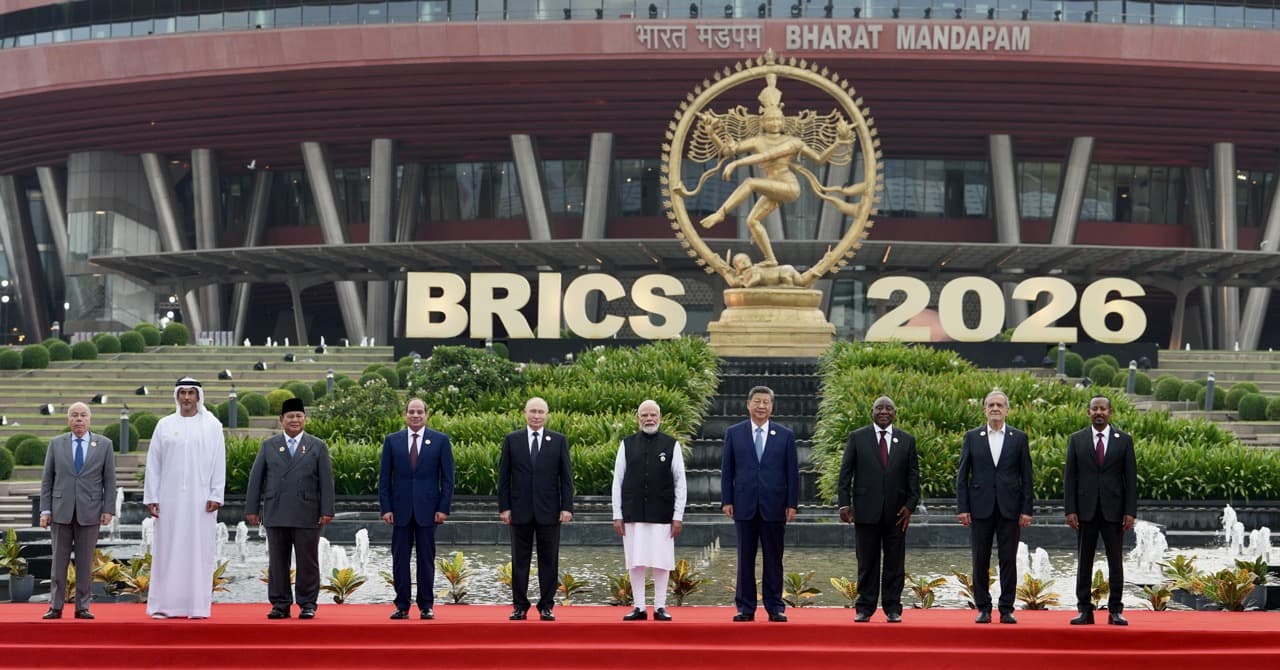
BRICS Summit in India
Photo: PIB.GOV.IN
BRICS leaders meeting in New Delhi are putting Iran directly inside the diplomatic room at a moment of rising energy prices and heightened Middle East tensions. The summit underscores how the expanded bloc is trying to present itself as a global counterweight while navigating deep divisions over war, sanctions and the West.
BRICS leaders gathered in New Delhi on Saturday with Iran seated at the table, giving the expanded bloc a direct voice as oil prices rise and the war in the Middle East reverberates through global markets. The summit matters because it highlights how BRICS members are trying to project unity and influence at a moment when the United States and its allies are confronting Iran from the outside rather than through a multilateral forum.
The meeting includes leaders from the bloc’s 11 members, among them Russian President Vladimir Putin, Chinese President Xi Jinping and Iranian President Masoud Pezeshkian, along with India’s Prime Minister Narendra Modi as host. According to reporting from the summit, the agenda has centered on trade, investment and international conflict, with the Middle East war, sanctions and strained relations with the West shaping the atmosphere around the talks.
BRICS began in 2006 as a grouping of Brazil, Russia, India and China, with South Africa added in 2010. India’s foreign ministry says the bloc expanded further in 2024 to include Iran, Egypt, Ethiopia and the United Arab Emirates as full members, and Indonesia later joined as a full member in 2025. India is hosting the summit this year after previously chairing the bloc in 2021.
Iran’s role shapes the summit debate
Iran’s presence has added urgency to discussions over energy, sanctions and global security. BRICS leaders issued a statement expressing concern about rising tensions in the Middle East and condemning sanctions not authorized by the United Nations Security Council. The statement also referred to attacks on civilian infrastructure and nuclear facilities under U.N. atomic energy safeguards, language widely read as criticism of U.S. and Israeli strikes on Iranian sites.
Pezeshkian has used the summit to press for greater use of national currencies in trade among BRICS members, an effort aimed at reducing exposure to Western financial systems. That message fits a broader theme running through the summit: several BRICS governments want the bloc to function as a shield against economic pressure and as a platform for countries that feel excluded from Western-led decision-making.
Modi, for his part, has tried to frame BRICS as an organization that is not aimed at any one country, even as the group positions itself as a louder voice for the Global South. Xi said China would work with BRICS members to help forge peace in the Middle East, while Putin called for greater representation for Asia, Africa and Latin America in the U.N. Security Council. The differing priorities of the members, however, remain obvious beneath the summit’s public show of solidarity.
The gathering also comes as wars in Ukraine and the Middle East, along with rising U.S.-China tensions, test BRICS’ ability to agree on a common line. Even so, the presence of Iran at the negotiating table gives the bloc a political weight Washington does not have in the same room, and that difference is central to the summit’s significance. The meetings in New Delhi are expected to continue through the weekend, with leaders seeking common ground on global conflicts, trade and the bloc’s broader role in world affairs.
Topics
Source: Ministry of External Affairs, Government of India
View original source ↗