
August 12 Total Solar Eclipse: Where to Watch, How to Stay Safe and What Asian Traditions Say About Eclipses
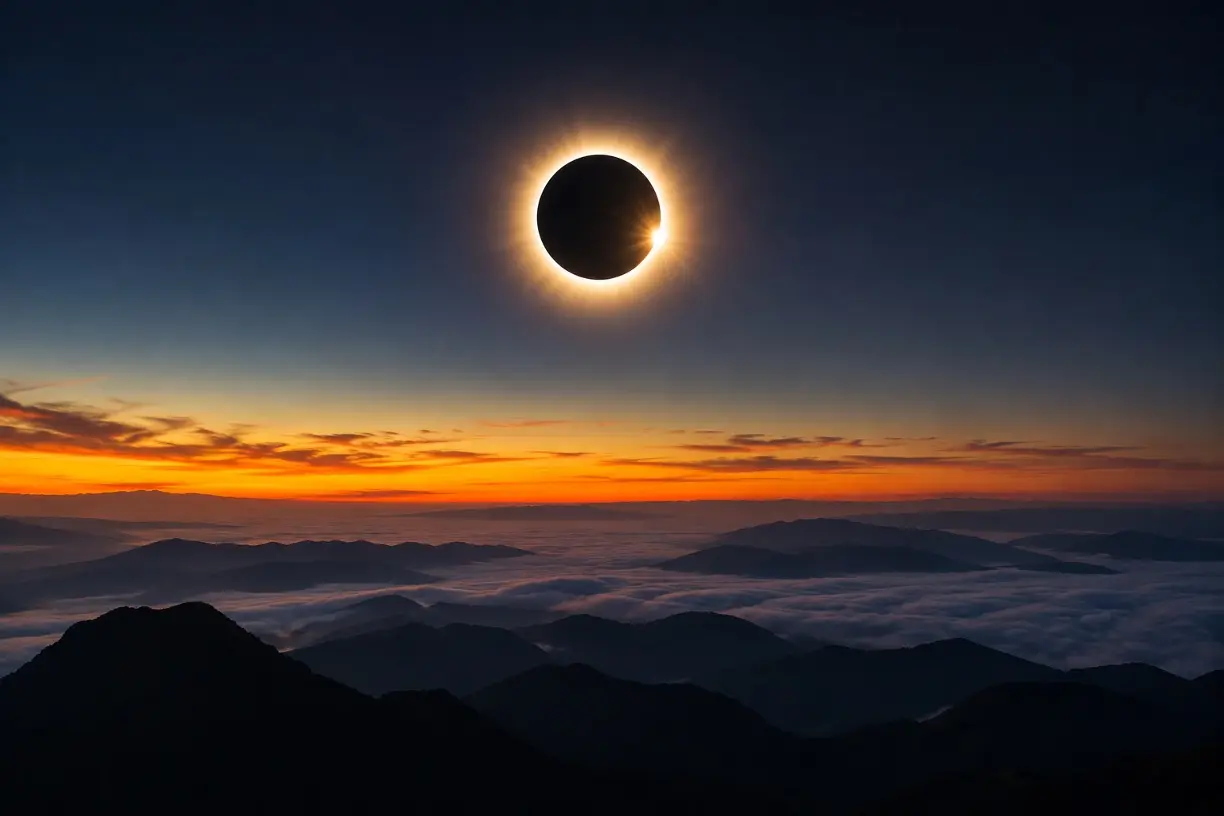
Solar Eclipse - AI Generated
A total solar eclipse will cross Greenland, Iceland, northern Russia, Spain and part of Portugal on August 12, 2026. Arizona will not see the eclipse directly, but NASA will provide live coverage of the event.
A major astronomical event will unfold on Wednesday, August 12, 2026, when a total solar eclipse sweeps across parts of the Northern Hemisphere, bringing daytime darkness to a narrow path through Greenland, Iceland, northern Russia, the Atlantic Ocean, Spain and a small part of Portugal.
Millions of people outside the path of totality will still experience a partial solar eclipse. According to NASA, portions of the northern United States, most of Canada, much of Europe and northwestern Africa will see at least part of the Sun covered by the Moon. NASA Science
Where Will the Eclipse Be Total?
A total solar eclipse occurs when the Moon passes directly between Earth and the Sun and completely blocks the Sun’s bright disk for observers within the path of totality. During those brief moments, the sky darkens and the Sun’s outer atmosphere, known as the corona, becomes visible.
The path of totality on August 12 will cross:
Northern Russia
Greenland
Iceland
The Atlantic Ocean
Northern Spain
A small area of Portugal
NASA calculations place the greatest phase of the eclipse at approximately 17:46 UTC, with maximum totality lasting about 2 minutes and 18 seconds near the center of the eclipse path. NASA Eclipse Spain is expected to attract considerable attention because the eclipse reaches the country late in the day. In several locations, observers will see the eclipsed Sun low in the western sky shortly before sunset. NASA notes that totality in parts of Spain will occur in the late evening. NASA Science
What About the United States and Arizona?
The continental United States is not in the path of totality.
A partial eclipse will be visible from parts of the northern United States, including Alaska and portions of the Northeast, Mid-Atlantic and Upper Midwest. NASA lists cities such as Boston, New York, Philadelphia and Washington, D.C., among locations that will experience a partial eclipse. NASA Science. Arizona is outside the region where the August 12 eclipse will be visible, so residents should not expect to see the event directly from the state. However, Arizona residents can still watch the eclipse online. NASA plans live coverage beginning at 1:15 p.m. EDT on August 12, featuring views from locations along the eclipse path. NASA Science
An Opportunity for Solar Research
The eclipse is more than a spectacular visual event. NASA scientists will use the temporary blocking of the Sun to study the corona, which is normally difficult to observe because of the brightness of the solar surface. NASA also plans observations using its WB-57 research aircraft, flying above much of Earth’s atmosphere and weather. Researchers will use the eclipse to study the Sun’s atmosphere and related solar phenomena. NASA Science
Understanding the corona is important because solar activity can affect satellites, communications systems, power grids and astronauts in space.
How Indian and Chinese Traditions Viewed Solar Eclipses
Long before modern astronomy explained eclipses through the motion of the Sun, Moon and Earth, civilizations across Asia developed their own interpretations of these dramatic celestial events.
In Indian Tradition: Indian traditions have long associated solar and lunar eclipses with Rahu and Ketu. One widely known account is connected with the Samudra Manthan, or churning of the cosmic ocean. In the traditional story, Rahu disguises himself and drinks the nectar of immortality. The Sun and Moon expose him, after which he is severed. Because he had already consumed the nectar, he survives, and later tradition associates Rahu with periodically swallowing the Sun or Moon during eclipses. India’s Press Information Bureau, in material from the Ministry of Culture, notes that eclipse traditions appear in ancient Indian literature and also discusses the Rahu story associated with the Samudra Manthan. Press Information Bureau. Some Hindu families continue to observe customs associated with eclipses, including prayer, fasting or bathing before or after the event. Practices vary considerably by family, region and religious tradition.
At the same time, India developed sophisticated astronomical explanations of eclipses centuries ago. Aryabhata, writing around 499 CE, explained eclipses through shadows and celestial geometry rather than supernatural causes. Press Information Bureau
The coexistence of mythology, ritual and mathematical astronomy is an important part of India’s long cultural relationship with eclipses.
In Chinese Tradition: The Sun Being “Eaten”
Ancient Chinese traditions also interpreted eclipses through powerful celestial imagery.
NASA notes that Chinese oracle-bone inscriptions from around 1200 BCE recorded eclipses with language stating that the Sun had been “eaten.” NASA Science. In later Chinese tradition, eclipses were sometimes explained as a celestial dragon devouring the Sun. The Chinese term historically associated with eclipse, shi, also carries the meaning “to eat.” Some accounts describe people beating drums and making loud noises in an effort to drive the dragon away. NASA Sciences & Exploration Directorate
Eclipses were also regarded as important heavenly signs connected with the emperor and the condition of the realm.
Ancient Chinese astronomers became exceptionally careful observers of eclipses. NASA notes that modern scientists at the Jet Propulsion Laboratory later used ancient Chinese eclipse records to study long-term changes in Earth’s rotation. NASA Science
Tradition Meets Modern Astronomy
Today, science explains a solar eclipse precisely: the Moon passes between Earth and the Sun, casting its shadow across part of Earth.
Yet the traditions of Rahu in India and the celestial dragon in China show how earlier civilizations sought to understand one of nature’s most dramatic events. They also illustrate how eclipses became intertwined with mythology, astronomy, royal authority and community traditions across Asia.
For Asian families following the August 12 eclipse, the event offers an opportunity not only to witness modern astronomy in action, but also to reflect on thousands of years of Asian cultural and scientific history.
Eye Protection Is Essential
Anyone traveling to see the eclipse should take proper precautions. NASA warns that it is not safe to look directly at the Sun during the partial phases of a solar eclipse without specialized solar-viewing protection. Ordinary sunglasses are not sufficient. Observers should use eclipse glasses or handheld solar viewers designed specifically for safe solar observation. Only during the brief period of complete totality—when the Moon completely covers the Sun for observers inside the path of totality—is it safe to look without solar filters. As soon as any portion of the bright Sun reappears, viewers must immediately resume using eye protection. NASA Science. Cameras, binoculars and telescopes require properly installed solar filters over the front of their optics. Looking through an unfiltered optical device can cause severe eye injury. NASA Science
A Global Skywatching Event
Although Arizona will miss the eclipse itself, the August 12 event is expected to draw eclipse watchers from around the world to locations including Iceland, Greenland and Spain. For those unable to travel, NASA’s live coverage will provide an opportunity to experience one of nature’s most dramatic astronomical events from anywhere with an internet connection.
The eclipse is also a reminder of the precision of celestial motion: for a few minutes, the apparent sizes and positions of the Sun and Moon align almost perfectly, turning daylight into twilight and revealing a part of the Sun normally hidden from human view.
For AZasians.us, I would put only this at the bottom:
Sources: NASA Science; NASA Goddard Space Flight Center; NASA Scientific Visualization Studio; Press Information Bureau, Government of India.
If your article editor has a separate Source URL field, I would use the main NASA eclipse page there and optionally add the PIB source in the editorial/source note.
One more recommendation: remove all ?utm_source=chatgpt.com parameters before publishing. They are unnecessary and make the URLs look untidy.
Source: NASA Science; NASA Goddard Space Flight Center; NASA Scientific Visualization Studio; Press Information Bureau, Government of India
View original source ↗