
Chinese Scientists Develop Oil-Refining Method That Could Sharply Cut Energy Use
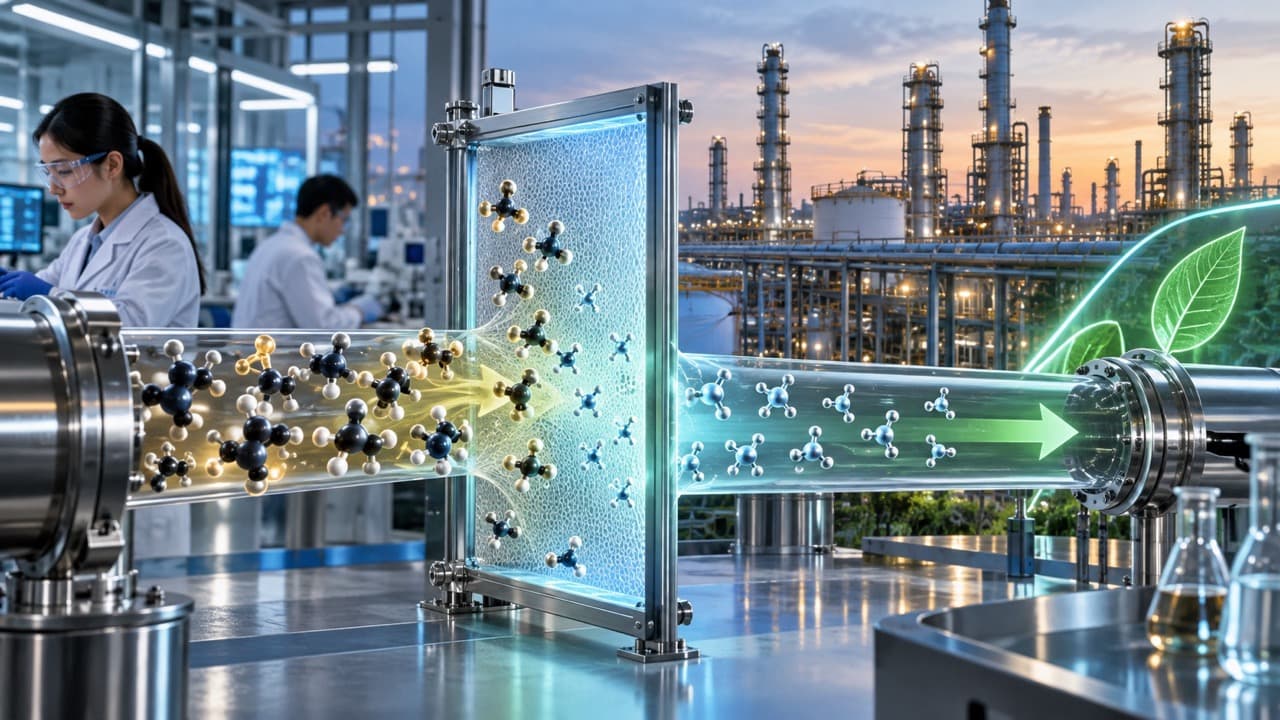
Researchers say membrane-based molecular refining could sharply reduce energy use in part of the oil-refining process
Photo: AI Generated Image
Researchers in China have developed a membrane-based “molecular refining” method that could reduce energy use in part of the oil-refining process by about 90% in laboratory and simulation tests.
Beijing, China — Chinese researchers have reported a new oil-refining approach that could significantly reduce the energy needed to separate valuable components from petroleum.
The study, published in National Science Review on August 12, 2026, describes a membrane-based process that separates light naphtha at the molecular level. The research team included scientists from the Dalian Institute of Chemical Physics, Chinese Academy of Sciences, and Sun Yat-sen University.
Traditional refining relies heavily on distillation, which separates petroleum components by repeatedly heating and cooling mixtures based on boiling points. The method is effective, but it consumes large amounts of energy because refineries must heat complex petroleum streams to high temperatures.
The new approach uses specially designed metal-organic framework membranes, known as MOF membranes, to sort molecules more precisely. Instead of depending mainly on boiling points, the membranes separate hydrocarbons by size and chemical properties.
Researchers created a two-stage, or graded, membrane system. The first stage separates straight-chain and single-branched alkanes from other hydrocarbons based on very small size differences. The second stage uses chemical selectivity to separate aromatic hydrocarbons from multi-branched and cyclic hydrocarbons.
In tests using a simulated light naphtha mixture containing 15 components, the system separated the mixture into three higher-value streams: ethylene feedstock, chemical intermediates and gasoline-blending components. The study reported recovery rates of about 85% to 90% for the product streams.
Most notably, process simulations estimated that the membrane cascade could reduce energy consumption by about 91% compared with conventional distillation for the tested separation.
The finding is important because refining and petrochemical operations are among the most energy-intensive parts of the industrial economy. If membrane separation can be scaled successfully, it could help lower refinery energy costs and reduce carbon emissions from some refining steps.
However, the technology is still at the research stage. The 91% energy-reduction figure comes from laboratory work and process simulations, not from a full commercial refinery. Real crude oil and refinery streams are more complex and may contain impurities that can affect membrane performance over time.
Before the method can be widely used, researchers and industry partners would need to test membrane durability, manufacturing cost, long-term stability, flow rates and performance under real refinery conditions.
Still, the study points to a promising direction for cleaner industrial processing. Rather than treating petroleum separation only as a heating problem, the new method shows how advanced materials may allow refineries to separate molecules with far less energy.
If the technology matures, it could become part of a broader shift toward more efficient refining and petrochemical production.
Category
Science & Technology / Asia
Hashtags
#ChinaScience #OilRefining #EnergyEfficiency #CleanTechnology #Petrochemicals #MembraneTechnology #ScienceNews #ArizonaAsians
Source Name
National Science Review
Source URL
https://academic.oup.com/nsr/advance-article/doi/10.1093/nsr/nwag488/8759696
Additional Reader Links
Editorial Comment
Sources include the open-access National Science Review research article, the Dalian Institute of Chemical Physics membrane engineering center and related public science reporting.
Topics
Source: National Science Review
View original source ↗Editorial Note: Sources include the open-access National Science Review research article, the Dalian Institute of Chemical Physics membrane engineering center and related public science reporting. Authors: Yuecheng Wang, Fang-Di Dong, Yujie Ban,Ziyi Hu,Dong-Dong Zhou,Jie-Peng Zhang,Xiao-Ming Chen,Weishen Yang