
Houthis deepen Red Sea threat as Saudi pipeline shut after drone attack
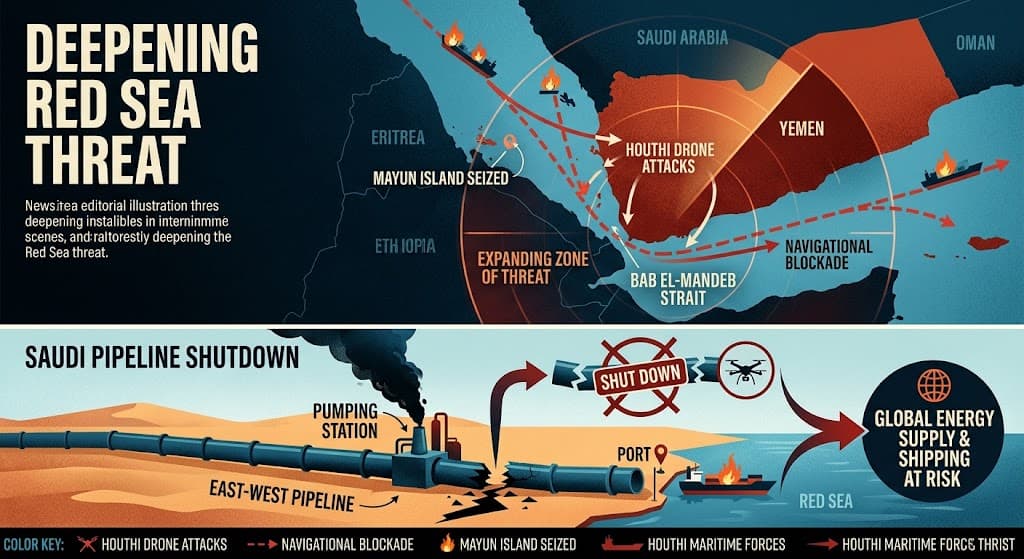
Deepening Red Sea Threat
Photo: AI Generated Image by Arizona Asians
Iran-aligned Houthi forces have advanced along Yemen’s Red Sea coast and reached positions near the Bab el-Mandeb Strait, raising new concerns about global shipping and energy markets. The move came as Saudi Arabia shut its East-West pipeline after multiple attacks, underscoring widening regional risk.
Iran-aligned Houthi forces have tightened their hold on Yemen’s Red Sea coast, moving closer to the Bab el-Mandeb Strait and heightening concern over one of the world’s most important shipping routes. The developments came as Saudi Arabia said it shut its East-West oil pipeline as a precaution after multiple attacks, underscoring how the wider conflict is now directly affecting regional trade and energy flows.
The latest fighting affects Yemen’s western coast and the narrow waterway between Yemen and the Horn of Africa, through which a significant share of global commerce passes. Yemeni government sources said the Houthis reached the strategic island of Perim, also known as Mayun, and took the coastal town of Dhubab, putting them in a stronger position near the southern outlet of the Red Sea. Saudi Arabia, meanwhile, said the attacks on its pipeline originated from Iraq and chose not to retaliate immediately.
The Bab el-Mandeb Strait has long been watched as a chokepoint for international shipping because vessels bound for the Suez Canal must pass through it. Control over the area gives armed groups the ability to threaten traffic across a route that links Asia, the Middle East and Europe. The latest Houthi gains follow months of regional escalation tied to the broader Iran war and the fighting in Yemen, where front lines have shifted rapidly in recent days.
Energy markets and regional security on edge
Saudi Arabia’s state news agency said the East-West Pipeline was shut down after multiple attacks on Thursday, Sept. 10, 2026, and the energy ministry described the closure as precautionary. The pipeline is one of the kingdom’s key export routes, allowing oil to move from eastern fields to the Red Sea coast. Its shutdown adds pressure to a region already rattled by threats to the Strait of Hormuz and by the Houthi advance along the Red Sea coast.
The Houthi push has also revived fears of broader disruption to shipping, insurance and oil prices. Reuters reported that Yemeni government sources believe the rebels’ reach near Perim and Dhubab could further increase the threat to maritime traffic, while Saudi officials have signaled they are still assessing the origin of the pipeline attacks and the appropriate response. For now, the situation leaves two critical maritime corridors under strain at the same time.
As fighting continues, the immediate question is whether the Houthis can consolidate their control near the strait or whether regional forces can push them back. For shipping companies, governments and energy markets, the answer could shape the next phase of an already volatile conflict.
Topics
Source: Saudi Press Agency
View original source ↗