
India’s Supreme Court Declares Safe Walking on Footpaths a Fundamental Right
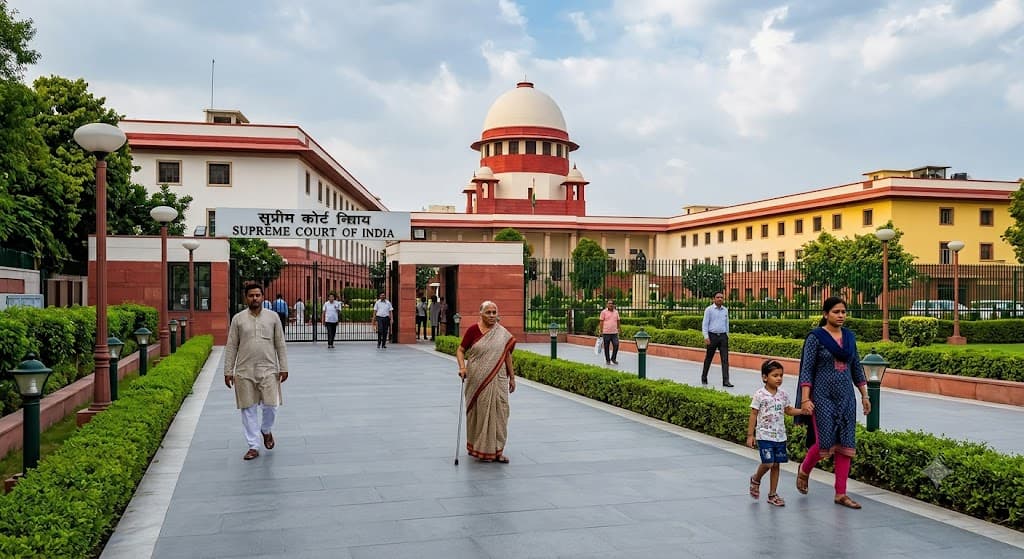
Supreme Court of India - AI Generated Image
New Delhi, India — In a landmark ruling with wide implications for urban planning and road safety, the Supreme Court of India has declared that citizens have a fundamental right to walk on safe, demarcated footpaths and that pedestrian movement must take priority over motorized vehicles.
The judgment was delivered on June 19, 2026, in Maniyar Iliyaz @ Shaik Riyaz and Another v. P. Ayyappan and Others. The bench comprised Justices P.S. Narasimha and Atul S. Chandurkar. The Court linked the right to walk primarily to the freedom of movement guaranteed under Article 19(1)(d), read with other constitutional freedoms and Article 21’s protection of life and personal liberty.
Tragedy Exposed a Wider Failure
The case arose from the death of a five-year-old boy who was struck by a tanker while walking to school with his father on a road that lacked a safe pedestrian pathway.
What began as a motor-accident compensation dispute developed into a broader examination of how Indian roads routinely place pedestrians at risk. The Court said that people should not be forced to walk alongside moving vehicles simply because authorities failed to provide footpaths.
The judgment stated that where a public road exists, authorities have an enforceable duty to provide and maintain a demarcated space for walkers. It also held that the right to walk on such footpaths overrides the privilege of motorized traffic.
Civic Bodies Given a Constitutional Responsibility
The ruling places responsibility on urban development authorities, municipal corporations, municipalities and panchayats to create, maintain and protect pedestrian infrastructure.
The Court emphasized that improving pedestrian safety does not always require expensive reconstruction. In many locations, authorities can begin by clearly separating walking areas using barriers, markings or other practical measures while permanent infrastructure is developed.
Citizens whose right to safe pedestrian access is violated may seek constitutional and legal remedies, including restitution and compensation, independently of claims available under the Motor Vehicles Act.
Court Finds Existing Law Inadequate
The Supreme Court was sharply critical of the existing legal framework, observing that the Motor Vehicles Act, 1988, was designed largely around vehicles and does not adequately recognize or protect the fundamental right to walk.
The Court called for a dedicated statutory framework and a full-time regulatory institution capable of planning, enforcing and monitoring pedestrian safety. It directed that the judgment be sent to relevant central ministries and the Law Commission of India for consideration of the necessary legal framework.
In a separate road-safety proceeding in May 2025, another Supreme Court bench directed states and Union Territories to develop policies for proper, unobstructed and disability-friendly footpaths. That order also required the Union government to constitute the National Road Safety Board within six months.
Accessibility Must Be Part of Footpath Design
The Court’s broader pedestrian-safety directions make clear that footpaths must be usable not only by able-bodied walkers, but also by senior citizens and persons with disabilities.
Accessible design may require continuous surfaces, ramps, adequate width, safe crossings and the removal of obstructions that force wheelchair users, visually impaired pedestrians and older people onto busy roads.
Follow-Up Focus on Enforcement
In an August 2026 follow-up, the Supreme Court directed the central government to ensure that roads have clearly demarcated and encroachment-free pedestrian spaces, reinforcing the practical obligations created by the earlier ruling.
The decision could influence road planning across India, where footpaths are often missing, damaged or occupied by parked vehicles, vendors, construction material and commercial activity.
A Shift in How Indian Roads Are Viewed
The ruling represents an important change in legal and civic thinking. Roads are no longer to be treated primarily as spaces for cars, buses and motorcycles. They must also protect the most basic form of mobility: walking.
For children, older adults, persons with disabilities and people who rely on public transportation, safe footpaths can determine whether schools, workplaces, hospitals and public services are genuinely accessible.
By recognizing walking as a constitutional right rather than a planning preference, the Supreme Court has placed a clear duty on governments to redesign public spaces around safety, dignity and equal access.
Topics
Editorial Note: Arizona Asians independently prepared this article using the Supreme Court’s official judgment and related public records.