
Proposed H-1B salary threshold change could strip exemption from nearly 50,000 filings, data analysis says
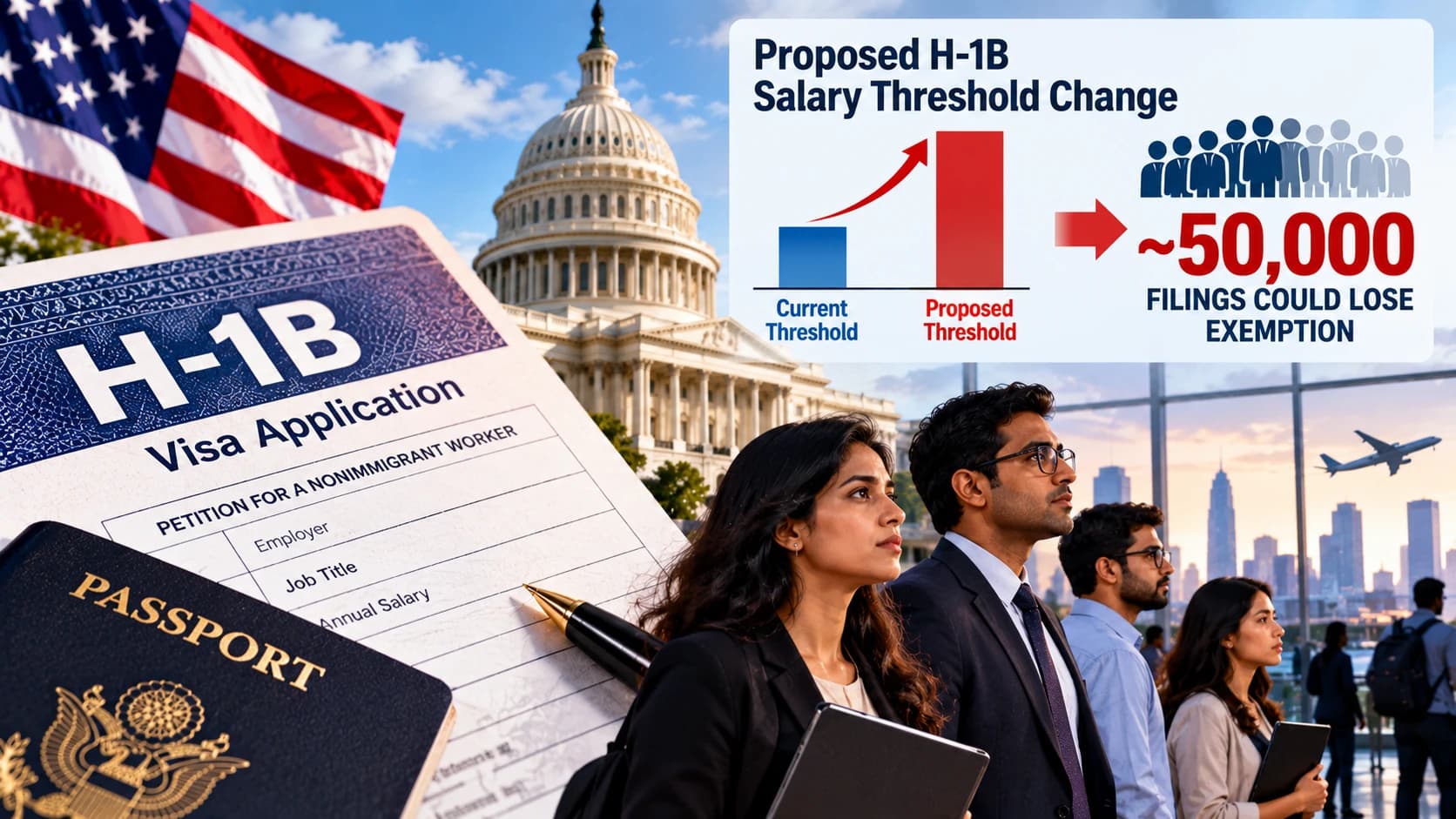
A proposed H-1B salary-threshold change that, according to data analysis, could cause nearly 50,000 filings to lose an exemption.
Photo: Arizona Asians / AI-generated image
A pair of proposed bills would lift the H-1B salary threshold for certain employers to about $145,600, potentially subjecting thousands more filings to added worker-protection rules. Federal data, labor regulations and recent agency proposals show the change could hit technology vendors, small employers and client-site placements hardest.
A proposed change to federal H-1B rules would sharply raise the salary cutoff that determines whether certain employers can avoid extra protections for U.S. workers, with a new threshold of about $145,600 based on the Social Security Administration’s 2025 national average wage index. If enacted, the measure would replace the current $60,000 benchmark and could affect tens of thousands of certified filings nationwide.
The proposal matters because it would apply to H-1B-dependent employers and companies found to have willfully violated H-1B obligations, not to every employer using the visa program. Those covered employers would face added attestation requirements meant to protect U.S. workers, including limits tied to layoffs, client-site placements and the duty to recruit qualified domestic applicants first.
The bills are being backed in Congress by Sen. Jon Husted, R-Ohio, and Rep. Glenn Grothman, R-Wis. Husted has argued that the current cutoff has let companies sidestep hiring protections for years, saying the threshold has not changed since 1998. The proposed formula would set the exemption line at twice the national average wage index published by the Social Security Administration, which equals $72,800.33 for 2025 and produces a threshold of about $145,600.
Who would be covered under the dependency rules
Federal rules define H-1B-dependent employers by comparing a company’s U.S. workforce, measured in full-time equivalents, with the number of H-1B workers it employs. Under the current framework, the smallest employers can qualify as dependent when they have 25 or fewer U.S. full-time-equivalent workers and more than seven H-1B employees. Firms with 26 to 50 full-time-equivalent workers meet the test at more than 12 H-1B employees, while employers with 51 or more workers become dependent when H-1B employees equal at least 15% of the workforce.
The additional attestations also apply to employers found to be willful violators within a specified five-year period. They do not apply to labor condition applications filed solely for exempt H-1B workers. Covered employers must agree not to lay off U.S. workers in similar jobs within 90 days before or after filing an H-1B petition, and the restriction extends to placements at client worksites. Before assigning an H-1B employee to a client, the employer must check whether the client has laid off U.S. workers in similar positions.
Employers subject to the rules must also recruit U.S. workers first and offer the job to an American applicant who is equally or better qualified. The Department of Labor’s H-1B guidance says employers must pay H-1B workers at least the actual wage paid to similarly employed workers or the prevailing wage for the occupation, whichever is higher.
A Manifest Law analysis of Labor Department records found that 49,587 of 392,175 certified filings from October 2025 through June 2026 could lose the exemption under the proposed threshold. That total could be lower if some workers qualify through a related master’s degree, which remains a separate path to exemption under the proposal.
Technology firms and Midwest worksites account for much of the exposure
The filings most likely to be affected are concentrated in the technology sector. About 91% of the potentially affected cases came from IT services and computer systems design companies, and the jobs were mainly software developers, systems engineers and programmers. Those employers accounted for about 31% of all certified H-1B filings in the period analyzed.
Median pay for the affected technology roles was $106,454, according to the analysis, which is above the current $60,000 cutoff but below the proposed threshold. Tata Consultancy Services, Cognizant, Capgemini and Infosys together filed about one in four of the potentially affected cases nationwide. Many of those companies place workers at client sites rather than in their own offices, making the client-site provisions especially relevant.
Ohio and Wisconsin also stand out in the data. Ohio worksites had 1,756 potentially affected filings out of 8,061 certified cases, or 21.8%, and about 82% of those filings came from employers based outside the state. Wisconsin’s share was 14.7%, with 414 potentially affected filings among 2,820 certified cases; employers based elsewhere filed 95% of those cases, led by Infosys and Cognizant.
Jeff Joseph, president of immigration strategy at Manifest Law and the 79th president of the American Immigration Lawyers Association, said the proposal could reach well beyond the tech industry. He said the change would narrow the exemption from H-1B dependency and increase the financial stakes of hiring H-1B workers, with the heaviest impact likely falling on small employers, startups and nonprofits that rely on visa holders.
Broader federal push would add fees, wage pressure and scrutiny
The salary-threshold proposal is only one of several recent federal actions that could raise costs or tighten review for H-1B employers. A Department of Homeland Security rule finalized in 2026 replaced random selection with a weighted lottery that favors higher-paid and higher-skilled workers, with the first affected lottery tied to employment starting in October 2026. DHS also proposed a separate $103,265 fee for each cap-subject H-1B petition.
The Department of Labor has separately proposed higher prevailing-wage floors across skill levels, including a move that would push the fully competent Level IV floor from roughly the 67th percentile to the 88th percentile of the relevant wage distribution. Entry-level floors would rise from about the 17th percentile to the 34th percentile, and the department estimated the change would add about $1.46 billion in H-1B employer costs in the first year.
Other measures already in motion would also increase pressure on employers. A final rule extended the existing $4,000 9-11 Biometric Fee to H-1B and L-1 extension petitions through Sept. 30, 2027, while qualifying employers generally pay an additional $4,000 for H-1B petitions and $4,500 for L-1 petitions when seeking an initial grant of status or a change of employer. A separate $100,000 fee imposed in September 2025 on employers petitioning for new H-1B workers from abroad remains blocked in litigation.
President Donald Trump’s September executive order also directed agencies to consider whether employers had conducted or planned layoffs when reviewing H-1B petitions and related applications, even though current law does not bar recent layoffs from hiring H-1B workers. A Congressional Research Service report dated Oct. 14 said DHS is also weighing changes affecting H-1B spouses, extension petitions and the 60-day grace period, with the public-comment period on one extension-related proposal set to close Nov. 13.
Taken together, the proposals point to a broader federal effort to make H-1B hiring more expensive and more closely scrutinized, while leaving Congress to decide whether to codify any of the changes or allow the administration’s approach to stand.
Topics
Source: Social Security Administration
View original source ↗