
US EB-2 Backlog Leaves Indian Applicants Facing Decades-Long Waits as Filings Stay Far Behind
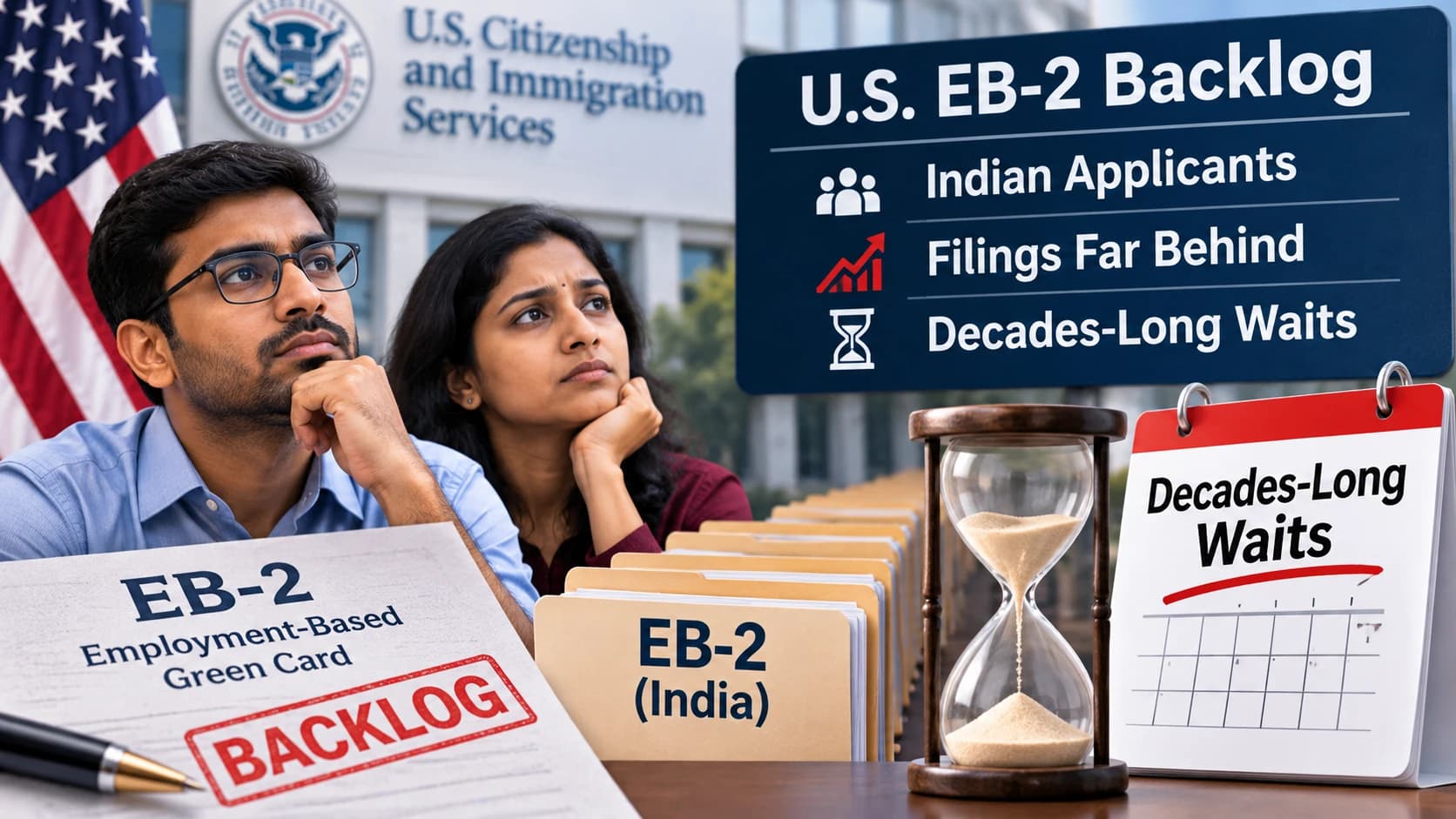
Indian EB-2 applicants face decades-long waits as the employment-based green card backlog continues to grow.
Photo: Arizona Asians / AI-generated image
Indian nationals continue to dominate the employment-based green card backlog, with federal and policy data pointing to extreme waits for EB-2 applicants. The latest visa bulletin keeps India far behind most other countries, while a separate H-1B proposal could add more scrutiny for workers who are already stuck in the queue.
Indian nationals continue to face the deepest delays in the U.S. employment-based green card system, with federal visa data and immigration-policy analysis showing that EB-2 applicants from India remain far behind the rest of the world. The latest filing chart for October 2026 places India’s EB-2 date at January 15, 2015, underscoring how far the category remains retrogressed for one of the largest immigrant groups in the queue.
The backlog affects workers, employers and families tied to long-running permanent-residence cases, especially in the technology and professional-services sectors. For many applicants, filing an adjustment-of-status case does not mean a green card will be approved soon; it only means a case can enter the system when a visa number is not yet available for final action.
The State Department said on May 22, 2026, that all EB-2 immigrant visas available for applicants chargeable to India had been issued for fiscal 2026, which meant no new EB-2 visas could be granted to those applicants until the annual limit reset on October 1, 2026. U.S. immigration law also limits employment-based and family-sponsored visas by country, keeping any single nation below seven percent of the total issued each year.
Filing dates remain far ahead of final approvals
The October 2026 USCIS adjustment-of-status filing chart shows that applicants in the EB-2 category may use January 15, 2015, as the filing date for India, while most other listed countries are far more current. China-mainland born applicants in EB-2 may file using January 1, 2023, and the filing date for all chargeability areas except those listed is March 15, 2026. Mexico and the Philippines are also listed at March 15, 2026.
That filing chart is different from the final-action chart, which governs when a green card can actually be approved. USCIS and the State Department use separate charts because a case may be accepted for filing even when a visa number is still unavailable for final adjudication. In practical terms, that means applicants can wait years after filing before their cases move to approval.
Earlier in 2026, the India final-action date in the EB-2 category had already moved back to September 1, 2013, according to the June 2026 Visa Bulletin. For applicants with older priority dates, the annual cap—not the filing itself—has been the limiting factor.
The National Foundation for American Policy estimated in an August 2026 policy brief that Indian nationals accounted for 79 percent of people waiting in the first three employment-based preference categories, and projected a 179-year wait for Indian EB-2 applicants filing from January 2026. The same analysis projected a 38-year wait for Indian EB-3 applicants filing from January 2026. The headline figure of 91 percent does not match that analysis, which counted 996,599 people from India out of 1,264,495 people in the first three employment-based queues combined.
The foundation also said the employment-based backlog could exceed two million by 2040 if Congress does not change the law. That projection reflects the combination of annual visa limits, per-country caps and sustained demand from workers already in the system.
Other immigration rules continue to shape the wait
For applicants stuck in the backlog, the wait does not always mean a complete pause in immigration-related benefits. Immigration attorney Nicole Gunara said applicants should not panic because the government may still accept filings, schedule interviews and issue separate benefits such as advance parole or work authorization even when a green card cannot yet be approved. WR Immigration has also noted that some applicants may keep H-1B flexibility under AC21 while waiting for a visa number.
Labor certification remains one important step in the employment-based process, and Department of Labor data show that a large PERM caseload remains in the pipeline. In fiscal 2025, the department received 117,849 applications, certified 138,093 cases and had 157,669 cases awaiting processing at the end of the fiscal year, down from 183,776 the year before. Analysts reviewing August 2026 data found an average processing time of 336 days.
Software developers accounted for 22.7 percent of all certifications in fiscal 2025, or 31,415 cases. California led all states with 24,409 certifications, followed by Texas with 14,138. The data show how concentrated the employment-based pipeline remains in occupations and states tied to the broader tech economy.
A separate Homeland Security proposal published on October 14, 2026, would remove the current requirement that USCIS defer to a prior approval when an extension petition involves the same parties and underlying facts. DHS estimates the rule change could generate about 6,044 additional requests for evidence each year and nearly $133,987 in added annual costs for petitioners. The public comment period closes November 13, 2026.
Immigration attorney Bhumireddy Sai Srinivas Reddy said the proposal would not change green-card queue positions or automatically invalidate existing H-1B approvals, but it could subject later petitions to renewed scrutiny while workers remain in the permanent-residence line. Rajiv Dabhadkar, founder of the National Organisation for Software and Technology Professionals, also weighed in on the proposal.
The backlog has also become part of a broader political debate over per-country limits. Congressman Josh Gottheimer highlighted the figures after an October 6 roundtable at the Palisades Park Library in northern New Jersey, where Assemblywoman Shama Haider, River Edge Councilwoman Priti Dhariwal and Yogi Virk, president of the Sikh Chamber of Commerce, joined the discussion. Gottheimer’s office said he has voted to eliminate per-country caps on employment-based green cards.
Gottheimer also pointed to the Sikh American Anti-Discrimination Act, introduced in January 2026 with Republican Congressman David Valadao of California. The bill would create a Justice Department task force on anti-Sikh discrimination, establish a federal definition of anti-Sikh hate, expand educational programs and require an annual report to Congress. His office said New Jersey is home to roughly 100,000 Sikhs.
The congressman said the community’s diversity is matched by a shared commitment to strengthening local communities, while adding that recognition alone is not enough. For many families already in the EB-2 pipeline, the latest visa bulletin suggests the wait is likely to remain long even as the fiscal year turns over and new numbers become available.
Topics
Source: U.S. Department of State
View original source ↗