
USS Theodore Roosevelt’s arrival in the Middle East heightens questions over the next phase of the US-Iran war
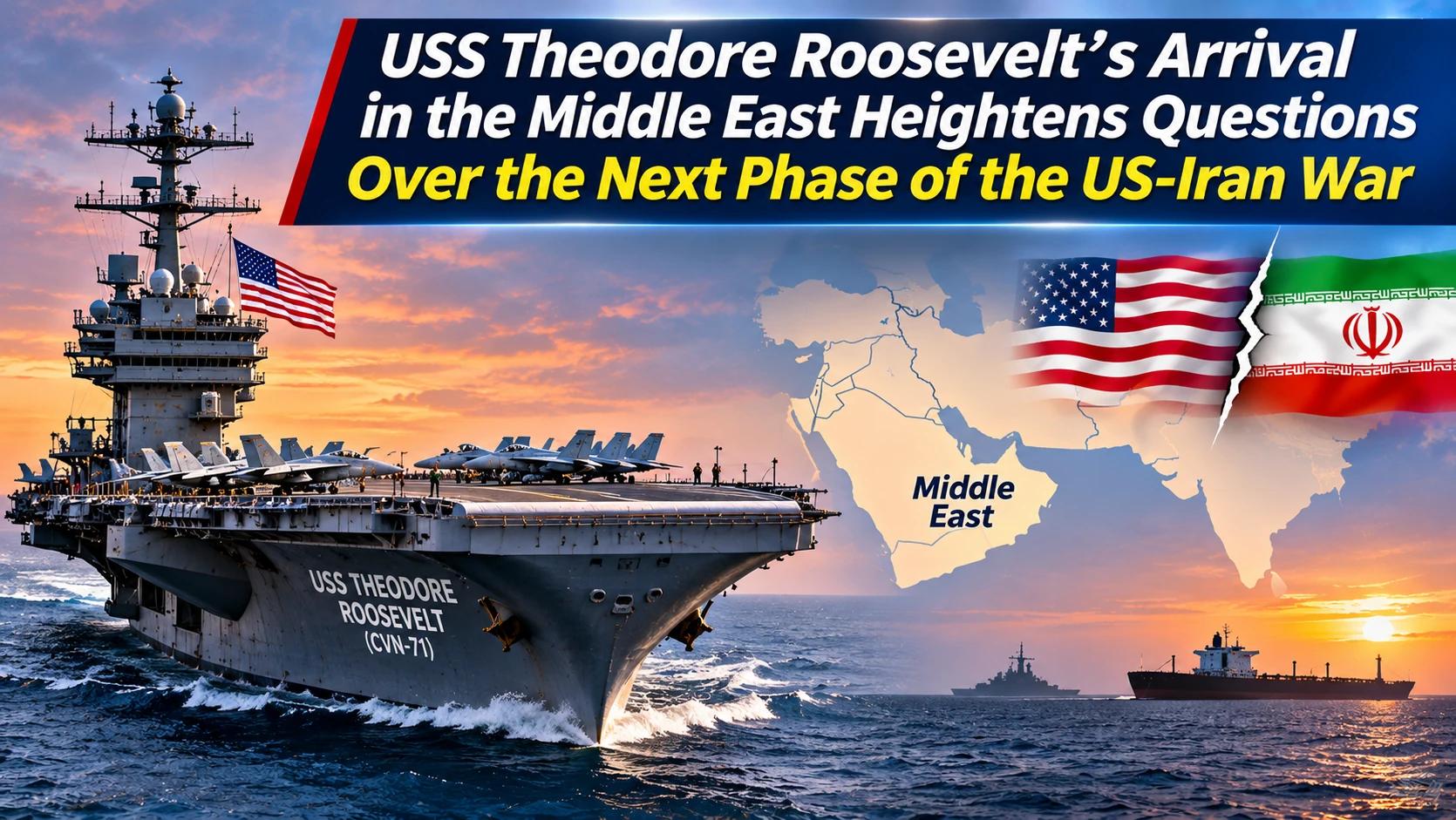
USS Theodore Roosevelt arrives in the Middle East as questions grow over the next phase of the U.S.-Iran conflict.
Photo: Arizona Asians / AI-generated image
The arrival of the USS Theodore Roosevelt in the Middle East has restored the region to an unusually heavy U.S. carrier presence, adding to speculation about whether Washington is preparing for another round of strikes against Iran. The deployment comes as U.S. officials and Iranian leaders continue to send mixed signals about escalation and diplomacy.
The USS Theodore Roosevelt has arrived in the Middle East, adding a third U.S. aircraft carrier strike group to the region and intensifying scrutiny over whether the months-long U.S.-Iran war could enter a new phase. The deployment is significant because it increases American military capacity at a moment when both Washington and Tehran are signaling uncertainty about what happens next.
A U.S. official told Al Jazeera that the carrier had reached the region, with one official saying it arrived on November 15, 2026. The buildup comes amid continued regional tension and reported attacks linked to the conflict, including strikes on U.S.-linked sites in Bahrain and other parts of the Middle East. The new arrival further raises the stakes for U.S. forces, allies and shipping lanes already operating under strain.
The Roosevelt’s movement follows a broader pattern of U.S. force posture adjustments tied to the war. Earlier reporting said the Makin Island Marine Expeditionary Force, carrying more than 2,000 Marines, also followed the carrier to the region, while additional aircraft including E-3 Sentry airborne warning planes, F-35 stealth fighters, F-22s, F-15s and F-16s have been reported in theater. That combination suggests the Pentagon has kept substantial air and naval assets within reach even as political signals have shifted.
Mixed signals from Washington and Tehran
The carrier deployment arrives as U.S. policy appears unsettled. President Donald Trump has alternated between warning of further large-scale strikes on Iran and saying the war is effectively over. On November 10, 2026, Axios reported that Trump said another round of strikes was “quite unlikely” and did not seem necessary after meeting with Qatar’s prime minister. At the same time, his administration has continued to maintain a strong military posture in the region.
Iranian officials have also sharpened their language. Kazem Gharibabadi, Iran’s deputy foreign minister for legal and international affairs, has warned that Iran “will not wait for the US to attack first,” and suggested Washington may be using diplomacy to buy time. Mohammad Bagher Ghalibaf, Iran’s parliamentary speaker and chief negotiator, has separately said Tehran wants to move beyond what he described as a state of “no war, no peace.”
The arrival of a third carrier also stands out as an unusually high concentration of U.S. naval power. AP reported that the Roosevelt restores the number of U.S. aircraft carriers in the Middle East to three, a level described as unusual. For regional governments, military planners and commercial shipping interests, the presence of that much firepower signals that the conflict remains volatile even if open escalation has paused.
What happens next will depend on whether diplomatic efforts can slow the cycle of threats and retaliatory posturing. For now, the Roosevelt’s arrival underscores that the United States is keeping its options open, while Iranian leaders continue to warn that they may respond before being struck again.
Topics
Source: Associated Press
View original source ↗